Langlois H2O by Bonnie Jensen Cox, April, 2026
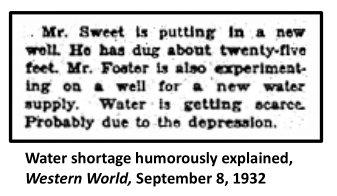
Waterworks are the lifeblood of small towns, cities, and metropolises alike. The complexities of the various systems are many, and when they are compromised consumers are anxiously reminded of their dependance on the liquid utility. Impediments that result in spiking turbidity levels and failed purification tests have a myriad of causes: Flooding during periods of heavy rain; droughts driven by climate change; equipment malfunctions; water source fluctuations; pollution from various animal sources; exhaustion of supply; byproducts from livelihoods; human malfeasance; and various other factors. What is the history of the Langlois water system, and how does it support life in the little coastal community?
THE SOURCE: The source for the Langlois water supply is Floras Creek that flows from Curry’s low-lying Coast Mountains, threading its way west as it slithers toward the Pacific Ocean. The creek is fed by tributaries that include the North, East, and South forks, a watershed encompassing 82 square miles inclusive of bottomland rich with alluvial soils. Earliest human benefactors of the waterway were the native Quatomahs who lowered their fish traps, launched their spears, bathed themselves and their children, and drew water in pitch-sealed baskets. As White people settled the area in the mid-1850’s, they claimed large spreads of land for themselves, and use of the creek took on a varied complexity what with the need for watering domestic animals, trapping wild animals, crop irrigation, the harvesting of local timberland, and the building of roads to land claims. Soon, the concepts of “water rights,” and later, “protection of natural resources,” and “sustainability,” came into play.
Historically, the name, “Floras Creek,” has been variously spelled and punctuated. Native Americans had their own name for the vital arterial which they referred to as “The Quatomah,” the same name as the band of the Tututni tribe that inhabited the area
(See note 1) Names applied by White people varied from “Flora’s” to “Flores,” to “Flore’s,” “Florey’s” to today’s “Floras.” Given its illustrious beauty in evergreen Curry County, one might suppose the name derives from the expression “flora and fauna,” but folklore suggests otherwise. In 1918, historian-journalist Fred Lockey asserted that the waterway was named by Lieutenant Stanton’s (aka Stoneman’s) exploring party when Fred Flora (aka Florey), a packer for the group, fell into the creek and, perhaps in some sort of humorous grappling and indignation, gave his name to it.
(S
ee note 2) Today’s accepted spelling is “Floras Creek.”
WATER USE HISTORY: Over time, multiple uses for Floras Creek evolved: A quarry for extraction of the creek’s preferred gravel used to build roadways; an energy source for powering small-scale sawmills and logging operations; an irrigation source for crops and gardens; a waterway for fur-trapping; a mineral source for sluicing and panning; a flushing place for human and animal fecal matter (
See note 3); a recreational site for picnics and swimming parties; and fishing grounds for the once bountiful coho, Chinook, steelhead, and cutthroat trout. A still or two made use of the arterial during Prohibition, the same creek where the local clergy conducted baptismal ceremonies. In 1951, swimming lessons for 91 local children were conducted in the creek’s cold, cold waters with nary a Porta Potty in sight. Historically, the creek has drawn large picnic crowds, e.g. the Curry County Dairymen’s Picnic with as many as 300 people in 1939, and again in 1954 when 500 attendees gathered.
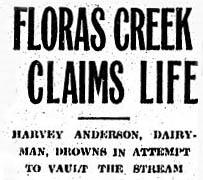
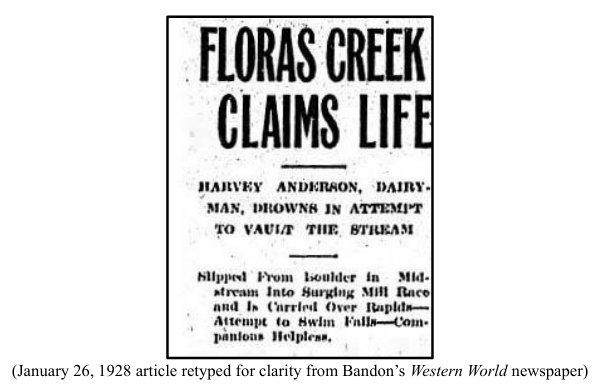
Rarely, but occasionally, a drowning victim has been pulled from the water as was the case in January of 1928 when local dairyman, Harvey Anderson, attempted to pole vault the creek near some rapids and slipped into the churning water. Two companions watched helplessly as Anderson, weighted with caulked boots and rain gear, was pulled under and drowned. (
See APPENDIX A for complete article).
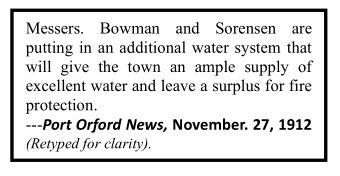
In 1912, Jens Sorensen, (a Danish immigrant and homesteader) and John Bowman, (local blacksmith and co-owner of Cheever and Bowman Hardware), formed a partnership to develop and maintain a waterworks for the growing town. The Sorenson/Bowman system served the majority of residents who did not have wells of their own.
Following dissolution of the Sorenson/Bowman partnership, William Sorensen, son of Jens, became sole owner of the water utility. When William retired around 1950, Art Aldropp (Norwegian immigrant and owner of the town’s automotive garage) became proprietor. The supply of water fluctuated with the seasons, and though it was filtered, it was not purified. Bobby Phillips Everest lived on Kerber Lane served by the Langlois utility. She remembered laundry days when she and her sister Shirley would have to haul buckets of clear water drawn from neighbor Court Guerin’s well so that the family’s clothing would not be stained by the water pumped to their home. And schoolchildren of the 1950’s and 60’s remember the slightly amber liquid that spewed from drinking fountains inside the school building. If they were thirsty enough, they drank it regardless.
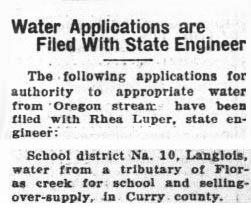
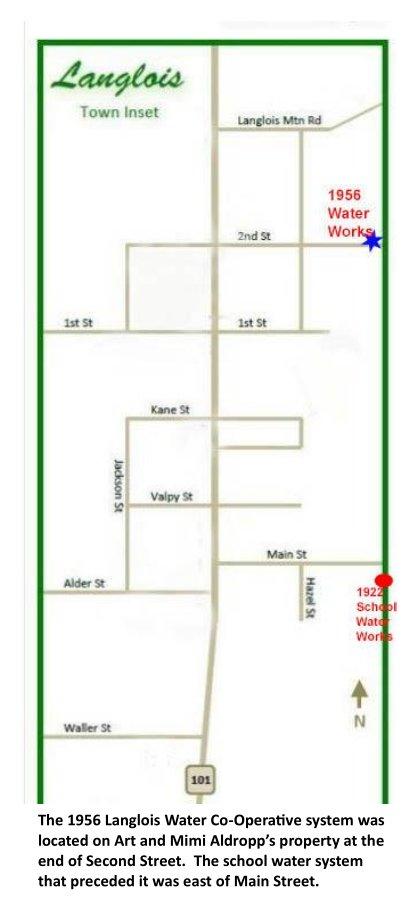
Ten years after Bowman and Sorensen acquired their water system, an optional water alternative was developed. In 1922, the building of a new schoolhouse for Langlois was underway. The administration of Langlois School District (then #10) filed papers with Oregon’s Secretary of State to gain approval for a private water system that would allow them to sell the “over-supply” to nearby residents. They floated a $3,000.00 bond for development of the utility and channeled water from Langlois Creek (
See note 4) to a tiny hillside reservoir. It would not replace the Sorensen-Bowman system, but rather offer another option for nearby users. In 2026, Vicki Kreutzer Elias remembered the rectangular cistern on her family’s property, and former Langlois Water District employee Mike Murphy recalled remnants of the concrete reservoir located in a draw and visible years later from his family’s home at the end of Main Street. Shade trees grew on one side of it, and water pooled at the base. The sides were approximately 8’ x 10’, creating a small 400-gallon reservoir, 5’ of which was visible above ground. Charles Gerber was trouble-shooter for the 1922 system which may have been abandoned when a new well was dug for the grade school in 1948.
Oregon Statesman, December 30, 1923. While the article above suggests the water source was a “tributary of Floras Creek,” today’s maps show that source as “Langlois Creek” which, like Floras Creek, joins New River before emptying into the Pacific Ocean.
Though the 1923 school water system served a few nearby residents, townspeople primarily received their water from the original Sorenson-Bowman system from 1912 through 1956, despite its seasonal fluctuations.
Western World, Bandon, July 7, 1934
Some people developed wells of their own.
THE 1956 CO-OP: As growth of the town’s population continued and maintenance of the water utility became more entangled, Art Aldropp was motivated to hand over ownership of the system that had been developed decades earlier. He envisioned a water authority publicly owned, one that could also support a volunteer fire department. In the mid-1950’s, he talked the matter up at meetings held in the new Sportsman Club and drew support from fellow businessmen. Under the sponsorship of the club a committee was formed, and from the coffers of that committee an attorney was hired and an engineering firm engaged.
Because Langlois was not an incorporated town, the nascent water district needed to file plans, diagrams, and maps with the State of Oregon that would make it a legal body capable of overseeing and maintaining a water system. Attorney Myron Spady of Bandon helped compose the Articles of Association for the Langlois Water Co-Operative, and the engineering firm of Cornell, Howland, Hayes and Merryfield in Corvallis was hired to prepare a detailed plan.
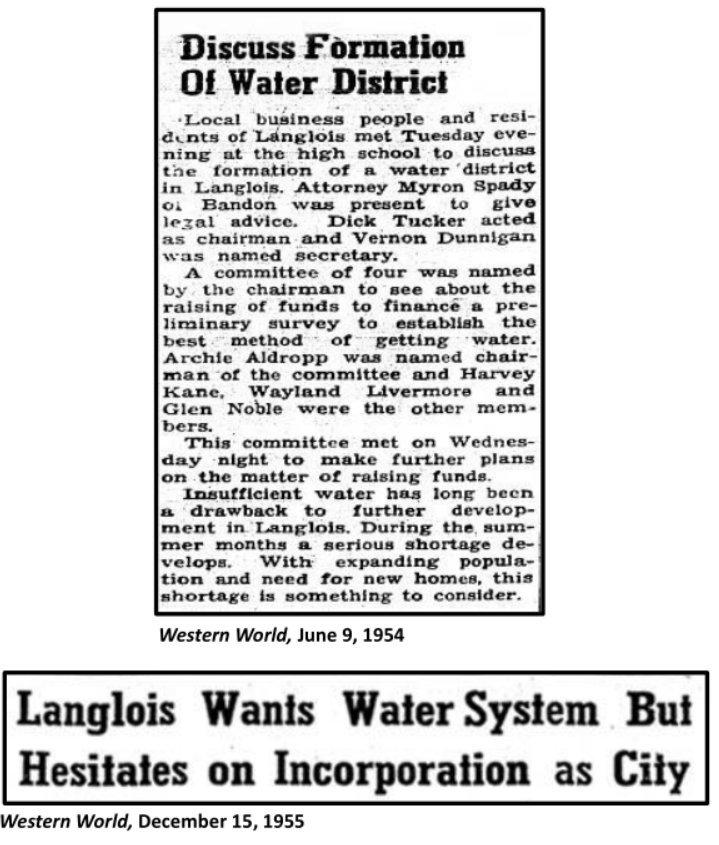
Regular meetings of the Langlois Water Committee ensued in the high school cafeteria. (
See note 5) In June of 1955, business people and residents held a public meeting chaired by R. D. “Dick” Tucker who, with an in-town sawmill, had a vested interest in water abundancy and fire protection. The committee’s goal was to develop a system that would meet the needs of 50 to 60 current users and be capable of serving additional customers as new residences and businesses emerged. A fundraising committee of four was named to come up with the means needed to launch a preliminary survey and develop a working plan. Archie Aldropp (son of Art and Mimi Aldropp) headed that committee which also included Harvey Kane, Wayland Livermore, and Glen Noble.
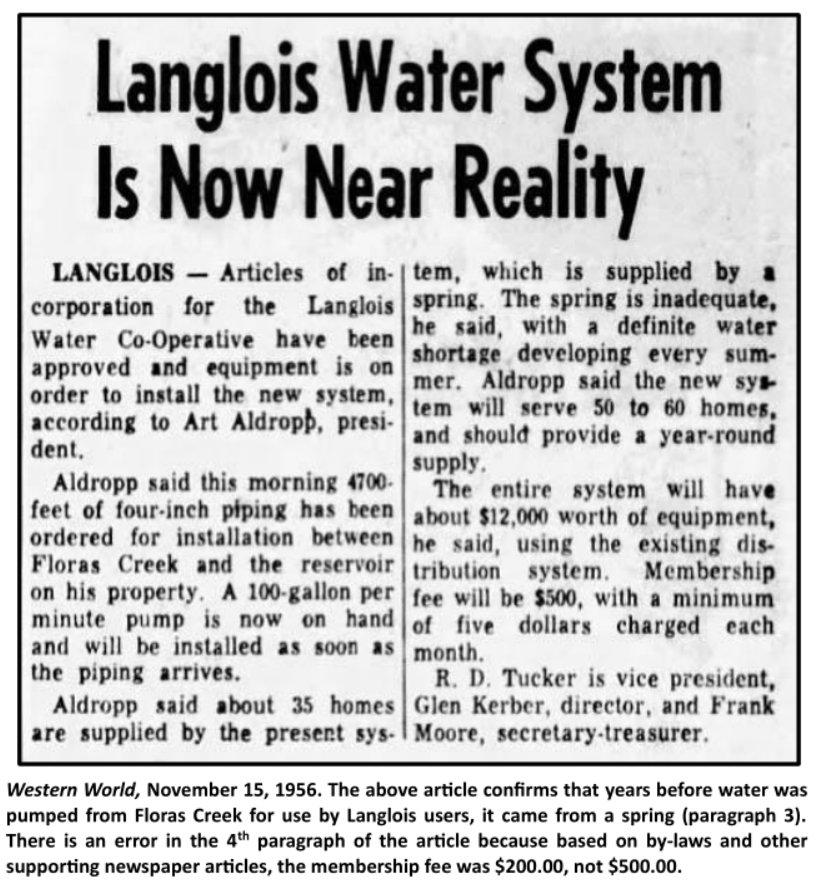
The exact location of the spring referred to in paragraph 3 of the above article is unknown, but logic suggests it was on elevated ground on the east side of the little town.
A community meeting in November of 1956 became headline news in local papers for much had been accomplished. A board of directors that included Art Aldropp, Frank “Dinty” Moore, R. D. “Dick” Tucker, Glen Kerber, and J. A. Phillips had been created; construction supplies had been ordered; and Articles of Association for a Langlois Water Co-Operative had been filed with Oregon’s Secretary of State. A 100-gallon per minute pump had been installed on land belonging to Art and Mimi Aldropp; 4,700 feet of four-inch pipe had been ordered; and officers had been elected.
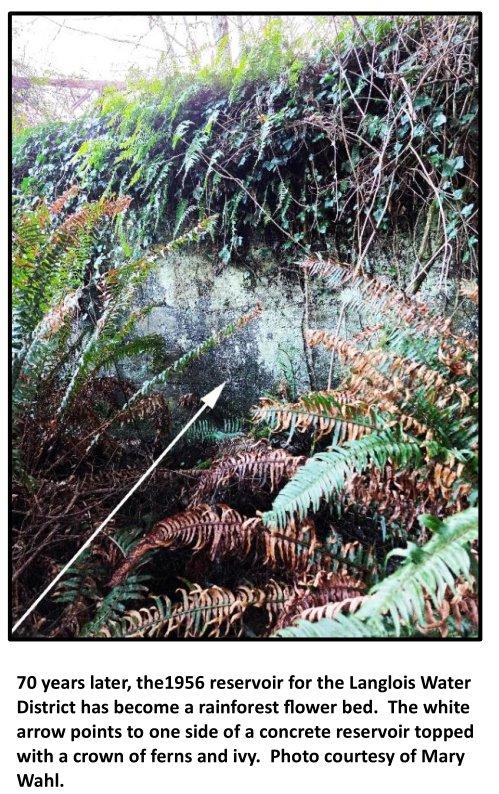
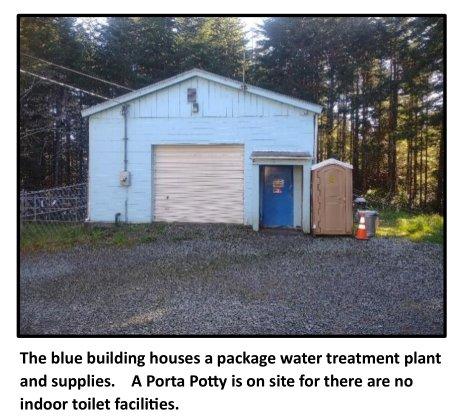
The slightly elevated location for the 1956 plant was approximately 80’ beyond the terminus of Second Street. Perhaps the most significant improvement to the new water supply equation was that the source would be Floras Creek rather than a spring. The main artery 4” intake pipe that carried water from Floras Creek had been installed----pipe made of Portland cement and asbestos fibers. The trenches for the 4” pipe that would bring the source water from the creek to the reservoir and pumping station were machine-dug by Art Aldropp and Ernie Hatmaker---a distance just shy of a mile. Shorter, lateral trenches were hand-dug by various volunteers. Next to the 20’ x 25’ rectangular cistern made of steel and concrete, Archie Aldropp constructed a building approximately 20’ x 22’ for protection of the pumping station and supplies. The matrix of old 2” distribution pipes that had been installed to carry water to Langlois consumers by Bowman and Sorensen years earlier would be utilized for the time being with plans to extend, improve, and replace lines as needed. Those original distribution lines had been laid using the most direct route from point A to point B with no apparent mapping of their whereabouts. (
See note 6) That approach later became problematic as some people (having no knowledge of what lay beneath the soil) built various outbuildings atop the distribution system which was only realized when leaks developed inside a woodshed or similar structure and needed to be accessed for repairs.
The new co-operative system was expected to serve up to 60 homes and businesses, almost double the capacity of the Sorenson system. The price tag was estimated at $12,000.00 which would be recovered with a buy-in membership fee of $200.00 and a $5.00 per month user fee thereafter. By some accounts, Art and Mimi Aldropp contributed a considerable amount of personal funds to develop the utility. The new system did not include a means of purifying the water being pumped to consumers, but nonetheless, Langlois Water Co-Operative had been formed and was a working entity.
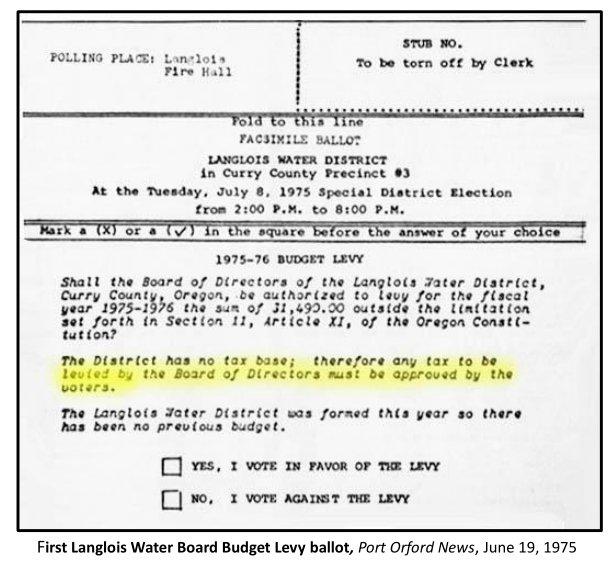
THE 1974 CORPORATION: The 1956 upgrades had been a community milestone, but over the next two decades needs for improvement and replacement of parts manifested in several places including the intake sight on Floras Creek; the delivery system to users; and at the water plant site on Aldropp property at the end of Second Street. In 1974, an assessment of the entire system was made. A chunk of money beyond that collected in user fees would be needed to upgrade the utility, but as a co-op the owners had no taxing or bonding authority. So, they began the legal process of forming a corporation that would be owned by the system’s users. The “Articles of Association” under which the co-op utility had conducted business were replaced in 1975. The organizational change gave the system corporate status, making it eligible to float bonds and receive tax dollars when the annual budget exceeded cash resources. Ancillary to that was the requirement to meet State specifications and undergo inspections by state agencies.
In 1975, the first ever taxing measure for Langlois Water District was put before voters:
The measure was unanimously approved---not one vote against. It was a historic outcome unlikely to ever occur again. Now the Water District potentially had several sources of funding: User fees, grant money, loans, and tax dollars. For some fiscal years, it was not necessary to seek voter approval for additional funds as the projected operating costs did not exceed the Water District’s bank account.
The new Second Street system on Aldropp property dispensed water for two decades with minimal improvements while deficiencies increasingly developed, then climaxed. Water tests conducted by a representative for the Curry County Health Department summarized the bad news:
A survey of the Langlois Water Cooperative facilities served to confirm the findings of a similar survey conducted by Mr. Colebank on May 7, 1973. The deficiencies outlined in Mr. Colebank’s letters of May 24, 1973, and April 3, 1974, still exist and still constitute a health hazard to the water users connected to the system. The basic problems with the existing facilities are inadequate storage capacity and improper disinfection, as outlined in the correspondence mentioned. Port Orford News, April 24, 1974.
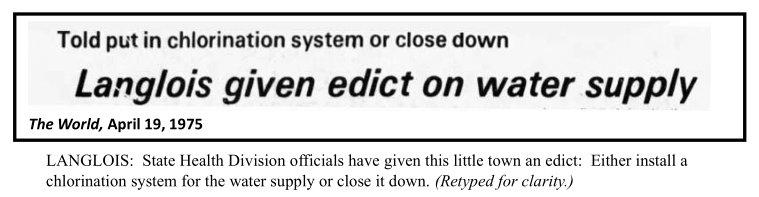
Then the real jolt, the threat of shutdown by the Oregon Health Division.
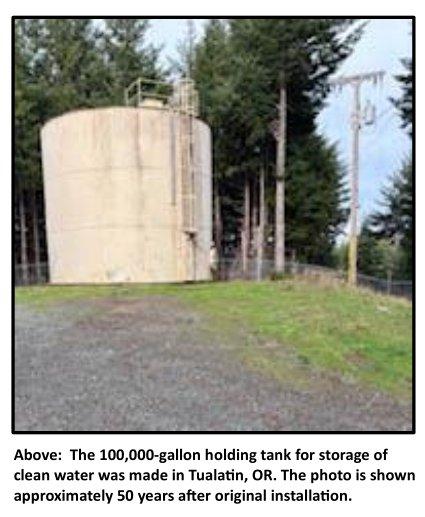
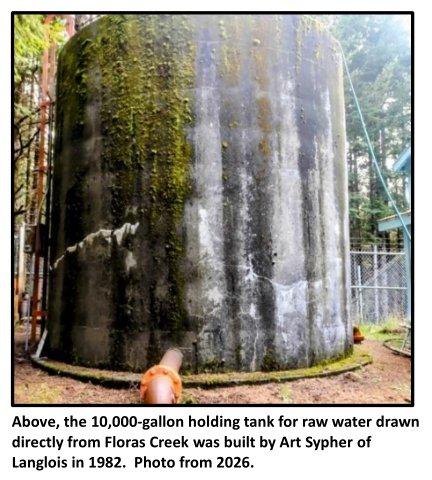
BUILDING A NEW PLANT: Schools would not be affected by the threatened 1975 shutdown because School District officials had installed chlorinators in 1974 at both the elementary school (aka “White Building”) and middle school (aka “Brick Building”), but other users were not similarly protected. It was an alarming situation, but perhaps the overhanging threat of shutdown was the spur needed to “think big” in terms of solving Langlois’s water problems. The short-term solution was to address immediate needs and continue to pump until mandated to stop. At the same time, LWD’s board began developing long-term plans for an entirely new site and system---one that would carry a near $500,000 price tag over a 20-year period. The proposal included a new hilltop location, a 100,000-gallon clean water tank and a 10,000 raw water storage tank, a wash plant, and the expense of installation. With its limited tax base, funds would have to come from outside sources.
In November of 1977, the Langlois Water District was awarded an FHA grant in the amount of $111,900 for water system improvements, but more was needed. In 1978, Langlois Water Board representatives approached the Curry County Commissioners for a loan in the amount of $175,000 to address needed upgrades that would include installation of a chlorinator. The solution meant selling the entire system:
GOLD BEACH: The Curry County Board of Commissioners Monday signed an agreement with the Langlois Water District to purchase the system for $175.000. (NOTE: The actual Purchase Agreement states that it was the “newly constructed portion of the system” that would be purchased).
The agreement simply allows Curry County to loan the water district the money to upgrade its water system, and as the money comes in for water use, it is repaid to the county.
The district then has the right to repurchase the system over a 20-year period by paying $8,750 per year, (loan repayment) and will continue to pay all maintenance and operation costs and will operate the system as it has in the past.
If the district fails to make the purchase payments each year, the county reserves the right to charge rent on the system or terminate the district’s right to purchase the remainder of the system, according to the agreement....” The World, March 21, 1978 Retyped for clarity.
It was an ownership risk, but seemingly essential at the time. The transaction was handled by attorney John Spicer of Gold Beach with commissioner Jack Waldie of Port Orford signing for Curry County and Walter Silberbauer (LWB chair) and Georgia Van Wormer (secretary-treasurer) signing for Langlois Water District. In 1998, twenty years later and two months early, the loan was paid off, restoring ownership of the utility to Langlois Water District. At a special meeting of LWB May 10, 1978, members decided to use $12,000.00 of the money from the Curry County loan to buy property for a new plant. (
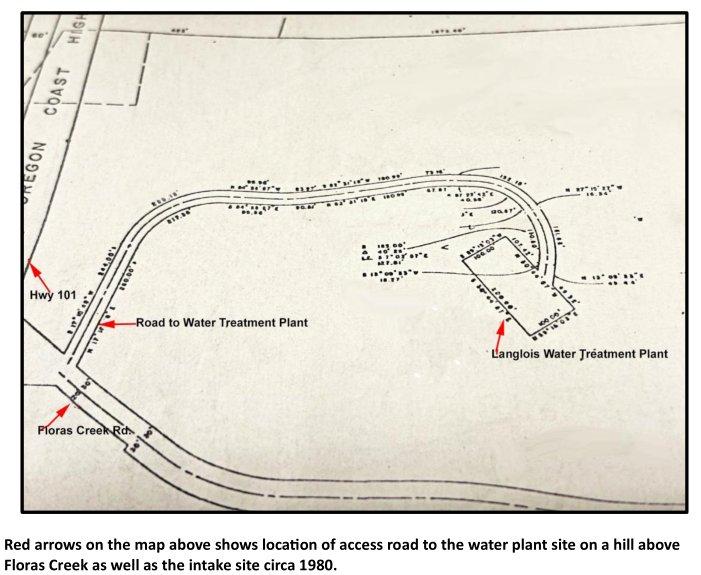
See note 7) The following month, 1.35 acres of hilltop land near the entrance of Floras Creek Road south of Langlois was purchased from James, Cleo, and Randy McWilliams for $12,000.00 (almost $60,000.00 In 2026 dollars). James was a logger from Myrtle Point and additionally built roads. Signing on behalf of Langlois Water District were Billy Barger Jr. and Joanne Barger.
A winding access road was carved up a small hill north of the entrance to Floras Creek Road where a hilltop plant site was leveled.
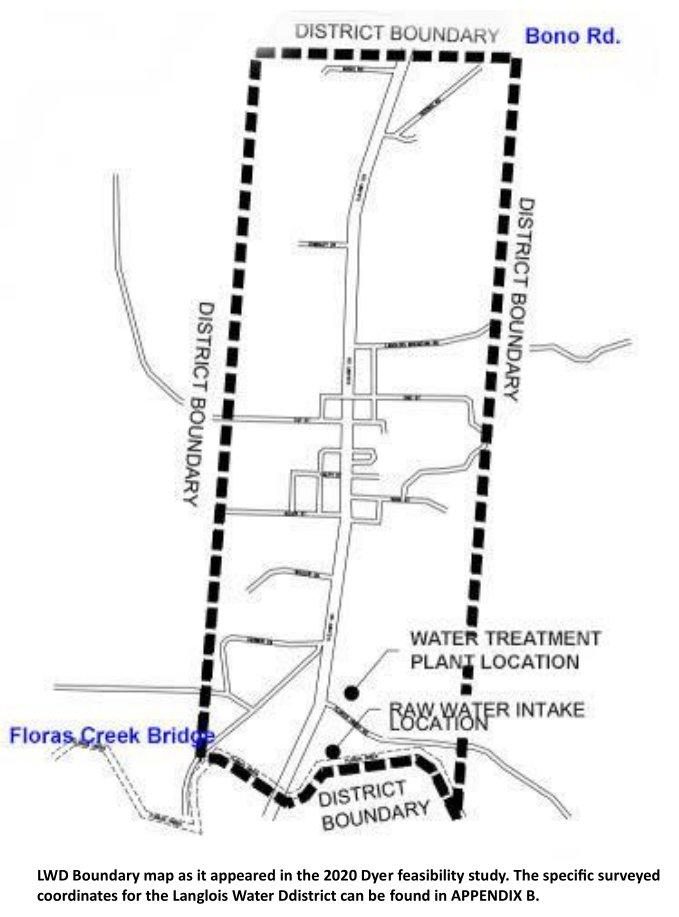
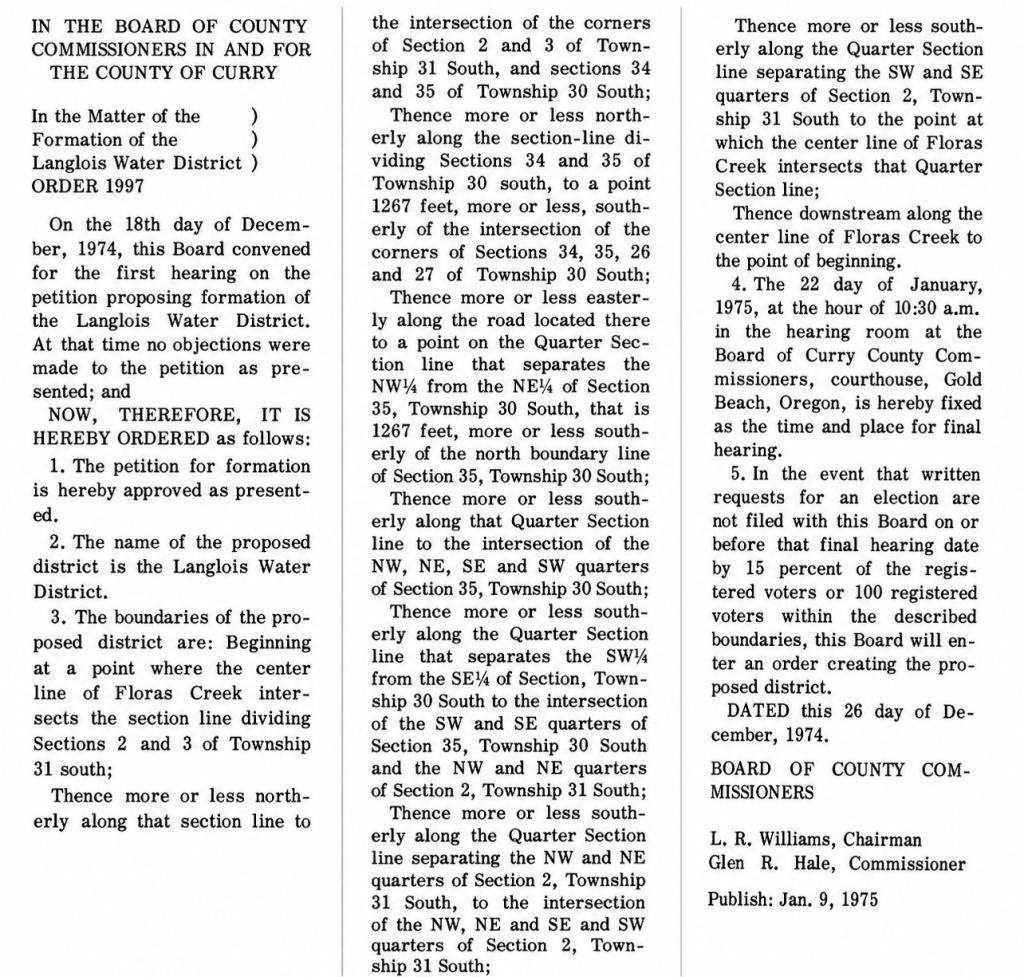
Since the LWD’s original conception, the boundaries of the water district have been expanded from time to time, resulting in an area that appears thus in 2020:
From 1974 through 1982, the needs of the water utility at the Aldropp site at the end of Second Street were singularly addressed while the new hilltop plant was developed in phases. Board members serving during that time of building and reconstruction included Paul Smith, (followed by son, Milt Smith in 1980) Walter Silberbauer, Wayne White, LaRue Henry, Eric Carlson, Georgia Van Wormer, Lester Higgins, Ernie Hatmaker, Glen Noble, Ed Nordstrom, and Gayle Nordstrom. But even as phase I of the long-term improvement project was in the works, users of the water pumped at the terminus of Second Street were notified in May of 1980 that the turbidity level exceeded state guidelines. Langlois people were frustrated while they awaited installation of the proposed new system. In September of 1980, some patrons sought the help of Curry County Commissioners:
|
GOLD BEACH: The Curry County commissioners Monday stepped in to try to help fix the Langlois water system which has been creating concern among north county residents.
Approximately a dozen Langlois residents came to the commissioners to seek assistance in getting a grant from the federal government. The commissioners agreed to seek the grant, but also instructed the county road crews to aid in a citizen attempt to fix the system. According to the residents, the water system originally built in 1956, has been plagued by problems of high turbidity and excesses of minerals.
Mrs. Tom Whitten presented the commissioners with a jar of water taken from her kitchen tap; it was discolored and cloudy.
Barbara Cripe, environmental sanitarian for the county, reported the latest Environmental Protection Agency tests on the Langlois water system showed turbidity and iron levels far above acceptable standards for drinking water.
According to Cripe, the EPA standard for iron is 0.3 milligrams per liter. Water taken from the Langlois system had 7.4 milligrams. The turbidity level was nine times the EPA standard, according to Cripe.
Ray Deets of Langlois complained he had suffered diarrhea from drinking the water and other residents confirmed similar health problems.
Commissioners Don Buffington and Mike Fitzgerald both cautioned residents not to count on a federal grant to solve the problem, but instead queried residents about a simpler solution.
According to Walter Silberbauer, the water intake system for the Langlois district is about four feet below the surface of Floras Creek.
Buffington and Fitzgerald advised the residents that the problem could probably be solved by digging down deeper and cleaning out the intake system.
Fitzgerald said, “I think 20 yards of ¾ inch gravel and some backhoe work would probably take care of your problem. You’ve got to go deeper to get cleaner water.”*
All three commissioners agreed to send county road crews and equipment to Langlois today to aid in a community water project.
The World Coos Bay, OR, September 9, 1980 Article retyped to improve readability
|
*In 1980, the depth of the original intake pipe at Floras Creek for the Second Street system was planted just 4’ below the bed of Floras Creek. Today, it is positioned 12’ beneath the creek’s bed.
In May of 1980, a local newspaper article asserted that LWB had just completed the first phase of a long
-term improvement project. That phase likely involved installation of a new 8” main artery pipe to replace the 4” AC pipe installed in 1956 which was made of Portland cement and asbestos fibers. The trenches needed for the wider pipe were dug 6’ feet apart from the 4” existing line to avoid tampering with the buried asbestos. Once the 8” pipe was in place, the old 4” main arterial line was abandoned.
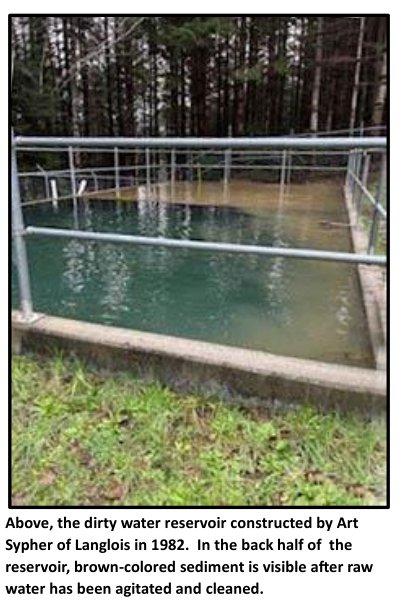
In June of 1981 the Langlois Water District received a federal HUD grant in the amount $135,000.00, the result of an application coordinated by Curry County’s Board of Commissioners. On May 7, 1982, a ground-breaking ceremony that included Curry County commissioners was held at the new hilltop plant site on Floras Creek Road with North Curry commissioner Shirley McKenzie Van Loo of Sixes using the County’s “Golden Shovel” to turn the first dirt. The ceremony was preceded by a gathering of the board and project planners at “Chowder Island” (aka “The Spoon” in 2026) who were served fresh donuts made by owner Wes Nedrow. Project detail included installation of a 100,000-gallon clean water storage tank, a 10,000-gallon raw water tank, a dirty water reservoir, a building to house the packaged filter unit, and installation of water lines from the intake site to the hilltop water plant for processing before being pumped to the community of users. In 2003, Wade Lindsay, LWD Manager, mapped the town’s distribution lines on a 3’ x 8’ piece of butcher paper that was later laminated and now hangs in the LWD office. (NOTE: See map in APPENDIX E of this article.)
Many times there were project setbacks related to misunderstandings, weather impediments, equipment failures, licensing and inspection delays, funding hold-ups, and (the most recurring) failed water tests as the result of old system failures and Floras Creek flooding. For much of the work on the new site, local laborers were hired including George Edwards who leveled a plant site at the top of a small hill; Art Sypher who constructed the plant’s building and poured the cement for both the divided dirty water reservoir and 10,000 gallon holding tank; and Art Allen of Port Orford who accomplished the electrical work. It was a momentous day when the self-contained Waterboy package plant was lowered into its new home (below) before the roof was added to the building.
GEOLOGIC HAZARDS:
There are several areas within the Langlois Water District that can be severely impeded by geologic hazards, those being earthquakes, high groundwater, erosion, and flooding. (
See note 8)
Earthquakes: Though there has not yet been a seismic event powerful enough to impact the Langlois water system, the 1991 earthquake near Brookings, OR gave water overseers serious concern. With the entire watershed for Floras Creek lying in a tsunami zone, a seismic sea wave would likely inundate Langlois and its surrounds within minutes following a major quake. The 500K USDA Rural Development Grant received in 2007 was to have covered the expense of installing a seismic valve that would shut down the system upon detection of a serious quake, but that installation did not happen.
High Ground Water and Erosion: In 1974 the Langlois Water Control District was formed to address ongoing issues of high ground water and erosion. It operated under the umbrella of the Curry County Soil and Conservation District which was a branch of the State Soil and Conservation District. The Langlois District was formed to help landowners on Floras Creek and New River (southern Coos County) take preemptive steps to reduce potential damage caused by flooding. To be clear, Langlois Water Control District was a separate entity from the Langlois Water District though they shared the common goal of keeping the flooding of Floras Creek in check. (NOTE: See APPENDIX D for a news article explaining the purpose of the LWCD). The Langlois Water Control District no longer exists. If there were to be significant flooding in the Floras Creek watershed today, the appropriate entity to consult would be South Coast Watershed Council which currently has two North Curry residents on the board.
Flooding: In an area that averages 71 inches of rain a year, there is bound to be problematic flooding from time to time. That was the case following several days of rain in December of 1980:
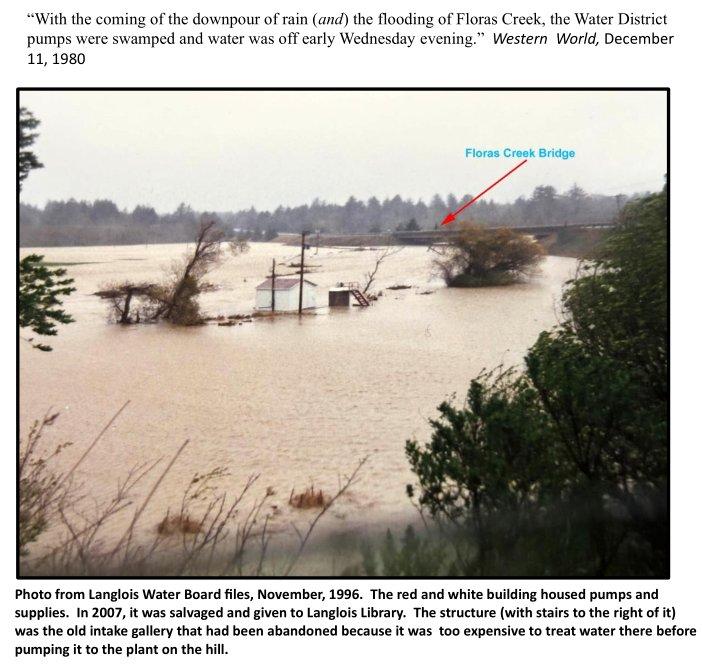
“With the coming of the downpour of rain (and) the flooding of Floras Creek, the Water District pumps were swamped and water was off early Wednesday evening.” Western World, December 11, 1980
The rains of December 2 and 3, 1980, brought 11 inches of water in a 12-hour period to north Curry County, producing flood stages two feet higher than had been observed in the past 60 years. The deluge eroded the creek’s banks, swamped the pumps, and undermined the creekside buildings. Water delivery to Langlois users was interrupted as crews (many of them volunteers) worked to salvage the intake pumps and flush the system. The November rains of 1996 resulted in a similar scenario causing flooding at the intake site as well as the access road to it (see above photo). Though the hilltop water plant had been completed in 1982, the intake gallery was from the 1956 system, its longevity compromised yearly by regular flooding of Floras Creek.
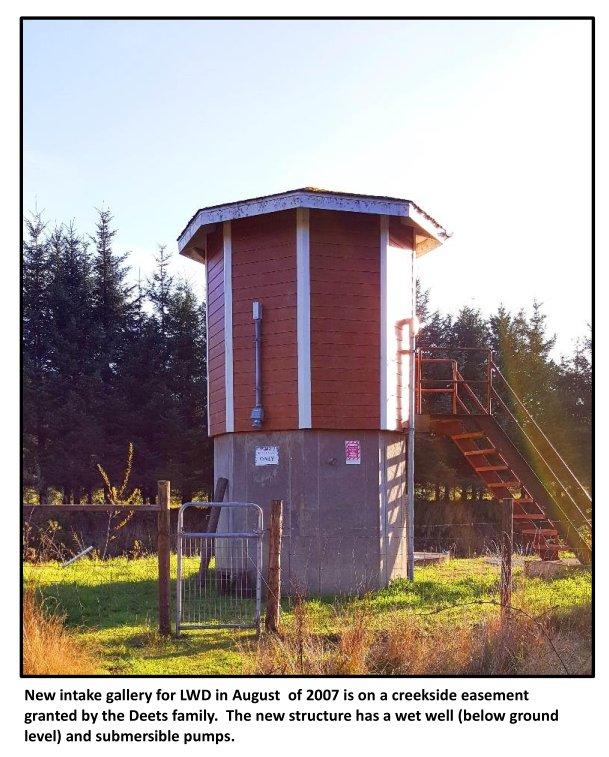
A NEW WATER GALLERY: In 2006, LWB and water district manager Dave Terrusa (LWD manager serving from 2004 to 2018) set forth on a plan to replace the creekside intake building with a new, elevated pump station that would reduce the impact of floodwaters. A preliminary engineering report for the intake operation was in part funded from Oregon Lottery proceeds.
Based on that report, a grant application was filed and in 2007, LWD became the recipient of a 500K USDA Rural Development Grant to be used primarily for construction of a new intake gallery. In 2026, it remains the largest grant ever awarded to LWD. The new elevated system was accessible via a 20’ wide easement road and building site granted in perpetuity by Alma and Ray Deets. (
See note 9) Though still located in a flood plain, the new pump station and power service were sheltered in an octagonal building mounted on an elevated concrete foundation standing 8’ above ground, the building completely assembled before being raised by a crane and set atop its base. It was built to withstand flooding up to 6 feet with stairs designed to break away if hit by a log or similar debris. (See APPENDIX F for diagram).
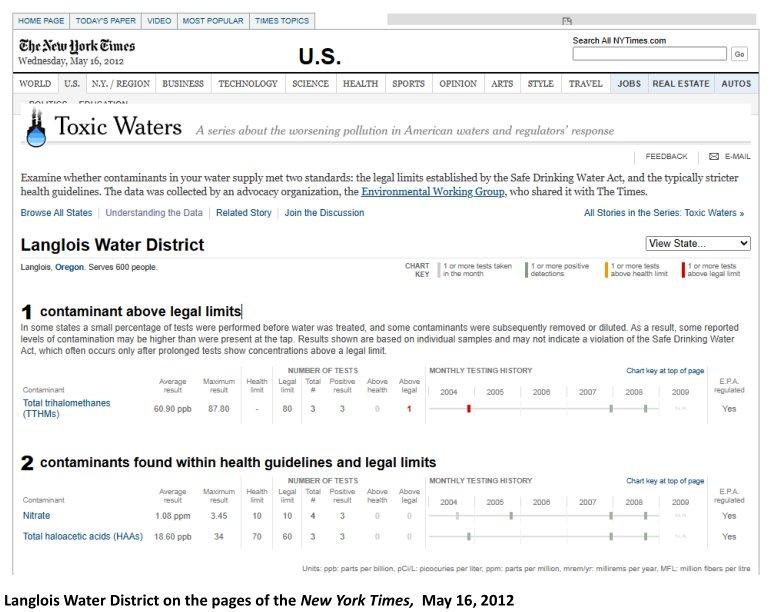
Despite the increased elevation, the intake gallery was flooded in 2012 along with Browns’ barn (on the former Lloyd Kreutzer property) and the gardens of Valley Flora. The turbidity levels and toxins brought by the flood were published on the pages of the New York Times May 16, 2012:
Langlois Water District on the pages of the New York Times, May 16, 2012
Also in 2012, a Porta Potty fell into the creek causing “blue-water” contamination from the chemicals used to treat the sewage. On that occasion it was necessary to include the Oregon Emergency Response System to assure the safety of Langlois drinking water.
Relief technician Z. McDermott spoke to the issue of system slowdowns that recur annually, not necessarily due to flooding, but enough rainwater to impact the distribution system: “Every year we've had to stop producing water for a day or two at least a few times. If we have enough in the tank, we sometimes (shut down) just to let it go down for a day and clear out a bit. The only time I've been here when we had to issue a boil water notice was when a valve broke and we lost a LOT of water (2024). That was followed by a big storm the next day. We had to get approval from the State to keep the tank from going empty.”
Z. McDermott continued, “Sometimes we'll get a slide up the creek somewhere and the little tank will just be full of mud. Then we usually shut down and let the water clean up, then run it out and start over. That can cost 5-6 hours or more. It's pretty common to have creek conditions affect operations. Sometimes it's so dirty we have to run it so slow we're not gaining at all, just kind of keeping up with demand. Usually, it’s the first big storm in the fall that causes the most problems since there is so much stuff built up during summer, particularly from logging run off. That's when even a regular big storm with no real flooding can shut us down. Also, during fall the alder and maple leaves, etc. make the creek into a tea that's hard to clean even if the water itself isn't that brown. This is why we try to keep 3 days+ of water in the 100,000-tank so we've got a little wiggle room before asking folks not to do dishes for a while.”
In January of 2024, high water warnings were posted by the LWD manager on social media and at public places after damage to a flocculation mixer during a period of high water:
DRINKING WATER WARNING
LANGLOIS WATER DISTRICT HAS HIGH TURBIDITY LEVELS
BOIL YOUR WATER BEFORE USING
The problem was identified as a malfunction of the flocculation mixer which started running too fast to create a floc:
“A floc is when chemicals coagulate on solids in the water and cause sedimentation of foreign debris which is then separated from the water. The water in the water tank will floc for a short while then it will stop causing the turbidity to climb back up. We are looking into an electrical variable speed switch to bring the rpm down of the mixer. We also have slowed down the flow to see if that will help create floc. We have brought our chlorine up to help with any disinfection for the higher-than-normal turbidity. Also, we have called the Oregon Association of Water Utilities (OAWU) for assistance. We are unsure of how long this process may take. We will update everyone through email or social media, i.e. Facebook and the World Famous Langlois website. (Posted on World Famous Langlois website and other social media, January, 2024, author unknown)
Former LWD manager Dave Terrusa recalled an incident when the Sullivan rock pit on Floras Creek Road located one mile or so upstream from Hwy. 101 overflowed. Terrusa recalled that as the tailings pond spilled into the creek,“...it became white with crushed fines (chalklike silt with larger and sharp-edged particles) for a few hours. The filter bed in the creek clogged until we did a backwash.”
There was no damage to the system itself on that occasion, but it is an example of how flooding can contaminate the Langlois water source.
COMMUNITY COOPERATION AND VIGILENCE:
From its grass roots to the present day, there has been community cooperation and vigilance of Floras Creek in an effort to assure safe drinking water for the people of Langlois:
When intake pumps were flooded in December 1980, volunteers stepped up to help restore water services. Water Board members thanked community helpers:
“Our special thanks to those who spent many hours standing in mud after the water receded to take out the pumps, repair the lines, and get water back into service Friday night. All of the residents of Langlois are happy and fortunate to live in a community where so many people really care.” Western World, December 11, 1980
And in 1981:
“According to the Water Board, due to efforts by property owners to locate and repair leaks on their property, the number of gallons of water pumped daily has been reduced considerably from an average of 110,000 gallons down to 45,000. These efforts are greatly appreciated by the district.” Western World, May 13, 1981
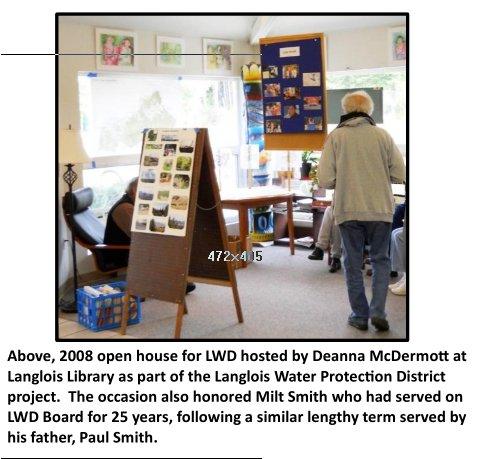
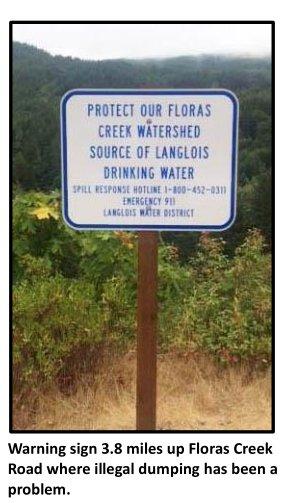
In 2008, Board member Deanna McDermott spearheaded the Langlois Drinking Water Protection Plan that included a watch group of landowners and residents to help monitor Floras Creek. The program was jointly sponsored by the Oregon Department of Environmental Quality and the Oregon Health Authority. In a PowerPoint presentation, McDermott outlined potential violation scenarios and the impact they might have on drinking water. “At the very least, trespasses can cause contamination, disruption of the water being transmitted to households, and the expense of testing and retesting to assure potability.”
After the violation and prosecution of one citizen in 2011, Deanna wrote of the need for public cooperation and thanked “those attentive residents for alerting the district to the recent unlawful and potentially hazardous garbage dump necessitating a ‘Spill Response.’” The incident resulted in a water system shut-down which triggered a safety issue by reducing the ready supply for fire-fighting. In addition to having to involve DEQ, OR Health Authority, Fish and Wildlife, DHS, State Police, LWB had the additional expense of water testing and manager’s time. The violator was identified and fined $1100.00.
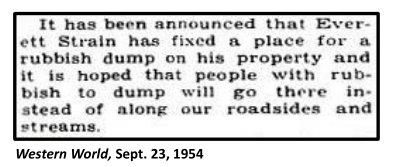
In 2014 an attempt was made to use Floras Creek as a cover for a full-size soda pop machine stolen from the porch of Langlois Market. The thieves apparently planned to remove the coins then conceal the machine by rolling it down a hill and into the creek about 3.5 miles up Floras Creek Road. But the weighty machine (estimated to be around 700 pounds) got held up by roots and stones on its tumble toward the creek, stopping short of the planned destination and avoiding contamination of the Langlois water source. Had it gone into the creek, extraction would have been difficult and expensive. (
See Note10)
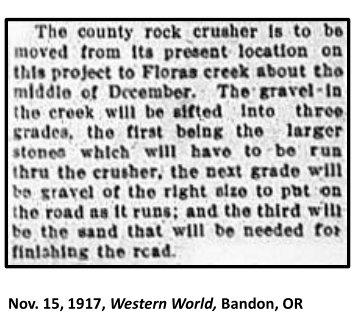
GRAVEL REMOVAL AND TURBIDITY: Historically it has not been uncommon for private parties, businesses, and even Curry County agencies to make use of Floras Creek gravel:
From time to time, such operations have been the source of increased turbidity or contamination, as was the case in 1982. In the July, 1981 LWD Board Minutes it was recorded:
“Tom Whitten opened discussion on the gravel removal in Floras Creek. He has not received any information as to time and amounts of gravel being removed. Tom feels that agreement and permits are not being used according to the way they were written."
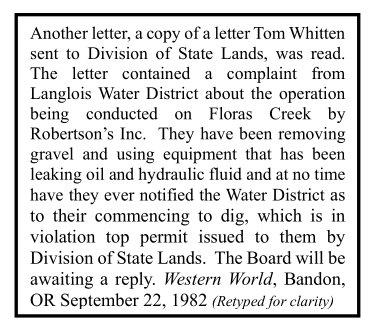
In September of 1982, LWB filed a complaint:
The removal of gravel from the creek is conditionally allowed by the Oregon Department of State Lands. The application must be accompanied by a basic permit fee of $700.00 to $2,100.00 (in 2026)---money that goes into Oregon’s Common School Fund. Such operations can cause increased turbidity as well as the expense and necessity of additional water testing. The response and outcome of the 1982 case reported by Tom Whitten is unknown, but should there be an individual or company that wishes to remove gravel directly from Floras Creek today (2026), the following information from Ben Carson, Aquatic Resource Coordinator, Department of State Lands provides guidance:
“It is still legal to remove gravel from Floras Creek, given that the proper permits have been obtained. The law that specifically addresses Commercial Gravel Operations is OAR 141-085-0585(6), and says the following:
(6) Limits on Terms for Commercial Gravel Operations. For commercial gravel removal, the Department will only issue a multi-year permit when it determines that:
(a) There is sufficient aggregate resource or annual recharge to allow the proposed volumes to be removed; and;
(b) The authorization holder has, for at least one year preceding the pending renewal, conducted removal in compliance with permit conditions.
The process of obtaining a DSL Removal-Fill Permit is outlined on our Removing or Filling Material page. It would require a Joint Permit Application (JPA) which is sent to DSL, the US Army Corps of Engineers, and the Oregon Department of Environmental Quality (DEQ).
Asked about permit costs and regulatory agencies, Mr. Carson answered:
- Fees are determined by a number of factors. I’ve included a FAQ sheet about our recent and future fee changes. The $700 or $2100 fee is the base fee, which, in the case of commercial gravel removal, would most likely be Type B: $2100. Additional Tier Fees are applied after we have received and completed a preliminary review of the application. How we determine what tier a project falls in is outlined in the attached FAQ sheet.
- After DSL has received a complete application (determined complete during a 30-day completeness review period), the application is sent out for a 30- or 60-day Public Comment Period. This would be an opportunity for the Langlois Water District Board to voice any questions or concerns. At the end of the Public Comment Period, all comments are sent to the applicant and relevant parties (consultant, other governmental agencies, etc.). Substantive comments relevant to DSL Removal-Fill rule require a response from the applicant. I’m not sure what went wrong in regards the Tom Whitten comment you’ve cited, but, at least now and as far as I know, the timing and amount of work would be included in any application sent out for public comment.
- Monitoring is completed on a case-by-case basis. Oftentimes, a commercial gravel removal project would require a post-construction report provided to DSL, typically within 90 days of project completion, as well as 1-5 years of annual reports for any revegetation aspects or other project components that may require monitoring.
According to the Department of State Lands there were no gravel removal operations underway on Floras Creek or with active permits as of March 16, 2026.
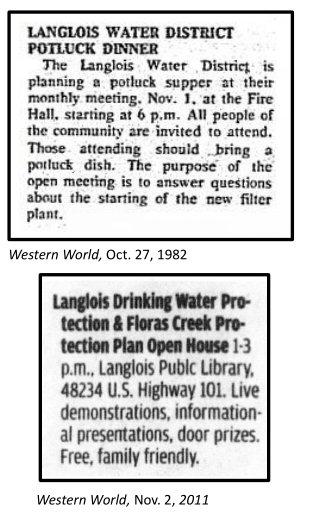
COMMUNITY TOGETHERNESS: Historically, a number of occasions for potluck dinners, open houses, and community attendance at Langlois Water Board meetings or events can be found in the local news.
But public meetings in which people physically gather in a common place to discuss LWD business went online shortly after the onset of Covid-19 and remain online to this day (March, 2026). (
See Note 11) Aside from an occasional exception, there is currently no plan to return to public meetings with a physical presence of attendees. People who wish to sign in to the online meetings or be included on the agenda may do so by utilizing the instructions listed on monthly agendas posted in public venues and on social media. No reservation is necessary, and the public is highly encouraged to be involved. Those who wish to tune in need to be equipped with (or have access to) a cellphone or computer. Cameras on the devices are optional as Zoom is set up with voice, camera, or both options.
TIES TO LANGLOIS FIRE DEPARTMENT: One of the original motivations for Langlois having a sufficient town water supply was for fire-fighting purposes. That need became apparent in the 1910 Langlois fire that destroyed half the town, the bucket brigade formed by townspeople having little impact on saving the westside business district. In the 1950’s, Art Aldropp and his cohorts planted the seeds and coordinated efforts for both departments to become a reality, but the evolution of the fire department is a story for another day.
Though Langlois water and fire departments are separate special district identifiers, they serve integral needs of the community---each relying on the other in times of emergency. Should a major fire occur within the Langlois Water District’s boundaries, it is the obligation of the fire chief to notify the water district manager that immediate surges in water system use will occur. Conversely, should there be a severe drop in water availability for the town, it is the expectation of the water district manager to notify the fire chief on issues of limited water availability.
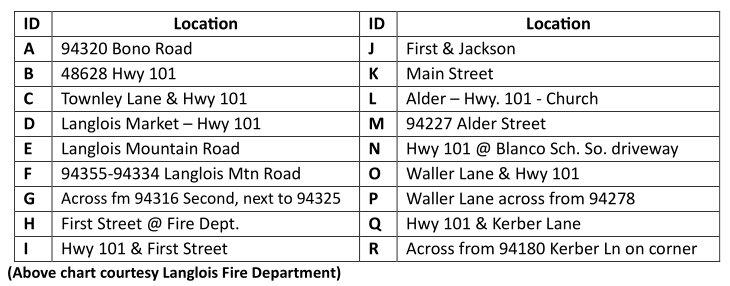
There are 18 fire hydrants located within the boundaries of the LWD, all of them installed and maintained by the LWD. They are tested periodically by both the LWD and the Langlois Volunteer Fire Department.
OVERSEERS OF LWD
Today, the Langlois water utility and the land on which it sits is owned by Langlois Water District. It is registered with the Special Districts Association of Oregon (SDAO) which oversees training, regulation, guidance, legal matters and insurance for all special districts. All legal authority and compliance are under Oregon and U. S. federal law. Additionally, LWD is monitored by the Department of Environmental Quality (DEQ) and the Oregon Health Authority (OHA) through testing, inspections, and reporting. (
See note 12)Langlois Water Board members are volunteers elected by voters within the LWD boundaries. In 2026, they include: John Waller, board chair; Hilary Johnson, treasurer; Marsha Swanson, secretary; and board members Rachel Swanson, and Judy Fitzgerald. The five board members serve four-year terms and meet once a month unless conditions require emergency meetings. The Budget Committee for LWD also consists of volunteers and meets once annually. Members are committed to three-year terms, and volunteer time per year amounts to only a few hours. Both the LWB and its associated budget committee have a chairperson, secretary, and treasurer. There is reimbursement for required training and classes that have registration fees. Mileage, meals, and lodging reimbursement are based on federal per diem rates.
In Oregon, water boards are required to have their financial records audited annually with one of the following two options: 1. If the total water district budget is less than $250,000., an “In Lieu of Audit” may be prepared and submitted to the Oregon Secretary of State for approval; 2. If the budget exceeds 250K, the water board would face an estimated $5,000.00 expense that fiscal year for an independent audit. That fee would mean an additional cost to each LWD resident of about $46.00 per year. To date, the annual LWD budget has not exceeded $250,000.
BYLAWS:
The most recent version of the Langlois Water Board Bylaws available in the LWD office is an unfinished 12-page document dated 2017. Use of the bylaws was discontinued altogether in 2017 based on the recommendation of the legal counsel at Special Districts Association in Oregon (SDAO) who suggested that by-laws can conflict with Oregon statutes. Instead, resolutions and motions were recommended.
THE HIRED HELP:
The essential tasks of keeping the LWD system running, bills processed, reports filed, water tested, meters read, etc. is divided amongst three individuals, though only one of them is full-time:
District Manager (DM): The position of DM is exempt from the requisites cited in the Fair Labor Standards Act (FSA). Based on the 2021 (and most recent) job description, the salary range for a fully-certified Langlois Water District Manager is between $26.000 – $36,000 +. “Actual Salary is based on education, experience, community size, and certification levels and is determined by Langlois Water District (LWD) Board of Directors.” In 2026, the average annual salary for certified water district managers in Oregon is $80,505. (
See note 13) Special certification requirements include endorsement from Oregon Health Authority; Oregon Drinking Water Services; and Oregon Department of Environmental Quality.
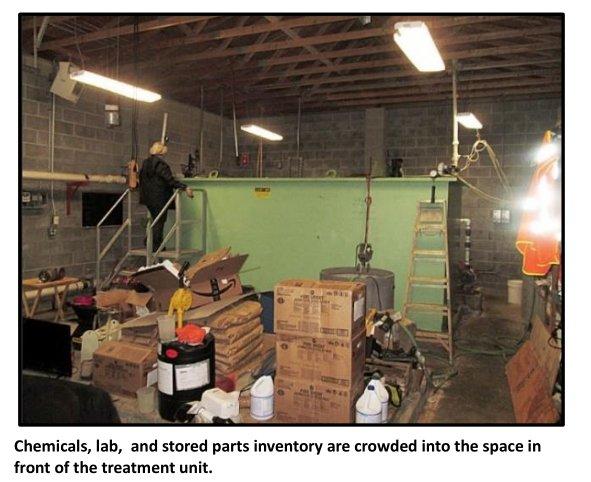
The District Manager’s job is broad-sweeping. In addition to maintaining and operating the water plant, the DM submits samples to testing labs; maintains the chemical and parts inventory; files reports with the DEQ as required; monitors meter boxes for maintenance and billing; and provides for repairs both at the plant site, the intake site, and in the delivery system. The federal rules governing municipal water systems were set forth in the Safe Drinking Water Act (SDWA) and signed into law December 16, 1974, by President Gerald Ford. Oregon law (Chapter 333 Division 061) covering maintenance of the state’s water systems came into law in 1981 and was driven by the federal SDWA of 1974. Whereas maintenance guidelines were originally contained in a pamphlet of 87 pages, now, in 2026, that publication has expanded to 350 pages. (
See note14)
The DM is the liaison between the Langlois Water Board and its employees. According to the position’s 4-page job description, “The DM will have varied work hours and must be available for emergencies and a variety of immediate situations.... this position requires being on call seven days a week, every week of the year.” (
See note 15) For fully-certified district water managers there is vacation time and extra compensation for work on federal holidays or for work in excess of 40 hours per week. The relief operator is on duty during DM’s time off.
If a fully-certified DM is not available, an uncertified applicant for the position can be hired to fulfill the duties of DM while he/she works toward full certification. Classes and testing can be accomplished online, and funds are budgeted by LWB for the training.(
See note 16) Because today’s DM is not yet certified, the LWB hires Ryan Sherman of Myrtle Point (a fully-certified water treatment operator and direct responsible party) to sign off on reports to overseeing agencies. The cost of hiring a direct responsible party is $600.00 per month.
Jesse Crim of Langlois, hired in 2025, currently fills the position of Langlois Water District Manager. As a contracted employee not yet certified, his current pay is $25.00 per hour. District managers who have preceded Crim include: Eric Carlson, Mike Murphy, Wade Lindsay, David Terrusa, Lennie Thayer, David Wyatt, and Kevin Gleason. Many of them served the district in various capacities and were volunteers long before they became hired help.17
Relief Water Operator (RWO) : According to the 2014 (and most recent) job description, the Relief Water Operator for the full-time District Manager is a permanent part-time position. Like the position of Water District Manager, the Relief Water Operator has FLSA-exempt status. While the pay rate is not specified in the 2014 job description, the current pay is $16.00 per hour for contracted employees. Minimum hourly pay in Oregon’s non-urban areas in 2026 is $14.05. The job description specifies that the relief operator must be available when the district manager has “regularly scheduled days off” and “annual vacations.” The RWO’s hours of employment vary depending on the need.
There is a paragraph in the Relief Water Operator’s job description that describes some of the environmental scenarios that might be encountered while fulfilling duties: “...wild life (sic) such as deer and racoons; uneven terrain both on and off-road; rain, wind, snow and heat; livestock in or near the intake site and in other places; confined spaces; isolated areas and rural locations; cranky and/or eccentric customers and other members of the public; motorists choosing to drive in an unsafe manner; lots of noise or lots of silence; toxic chemicals; nasty smells; dimly lit places or places which are too brightly lit; more wind, more rain; fumes from vehicles and fumes from cattle; barking dogs and guard geese; and other environmental factors associated with working outdoors in a rural farming community.” (
See Note 18) Z. McDermott of Langlois, hired in 2022, currently fills the position of Relief Water Operator.
Administrative Clerk: Presently (2026) the most current job description for the Office Clerk/Budget and Billing Coordinator is from 2021 and varies slightly from current duties. Requisites cited in the 2021 job description include computer skills for apps such as QuickBooks, Excel, and Word; understanding of billing and receipt functions; ability to prepare financial reports; maintenance of office cleanliness and organization; a valid Oregon driver’s license; and ability to perform additional duties as required to assist in water operations. Anne Redding currently fills the position and was hired in 2024. She works up to 9 hours a week and is paid an hourly wage of $17.50. In addition to duties and responsibilities listed in the 2021 job description, she: Collects and processes mail; responds to emails; prepares financial reports; processes payments; prepares deposits; responds to customer and public inquiries; orders supplies and materials; completes and submits reports to state and federal agencies; attends board meetings; assists with meter reading as driver and helps flush lines; assists the District Manager with critical decision-making; and coordinates both staff and board training sessions. The position is not exempt from the Fair Labor Standards Act.
Because there is no company vehicle, all three workers use their personal vehicles when conducting business for LWD both inside and outside the district. Compensation for job-related travel for LWD business (e.g. travel to a testing lab in Coos Bay) is reimbursed at .725 cents per mile in 2026.
Uncertified District Managers and Relief Water Operators have the option of being independent contractors (i.e. 1099 employees.) Choosing to do so means no benefits, no vacation time, and no overtime pay. While there is no in-district mileage paid to DMs who are independent contractors, there is compensation for out-of-district travel. In-district travel can amount to a $100-$200 monthly expense for DMs not yet certified. Contracted employees pay their own taxes.
For all LWD positions, hiring preference is given to military veterans.
WATER FEES: Today’s base rate for the LWD utility is $40.00 per month for users inside the LWD utilizing 5/8” to ¾” meter (
See note19) pipe, and $41.50 for users inside the district having 1” meter pipe. In 2026, the base charge for new service users is $5,000.00 residential, and $6,000.00 commercial. A complete list of fees appears in the Appendix C of this article.
The meter system installed in the 1980s must be read by visiting the physical site of all 115 clients. During the period 2020-2021, all analog meters in the district were replaced with digital. Anne Redding described the monthly routine of meter-reading (April, 2026):
“Meter-reading is conducted on the 28th of the month regardless of the weather or day of week. The process requires two people and three hours. Presently, it is accomplished using a Sensus Autogun wand that “reads” the sensors attached to the tops of meter boxes. Halfway through the 12-mile route the wand memory gets full, requiring the meter readers to note and record the numbers onto paper for manual entry into the billing software. Opening the meter boxes for manual reads often necessitates clearing them of dirt, water, sow bugs, slugs, or yellow jackets.
“At the same time meters are read, lines are flushed at the end of several streets.
“In March, 2026, LWB approved the purchase of new billing software and an Autogun wand with the ability to transfer data via cellphone. The new tool will ease the process immensely, avoid human error and exposure, plus eliminate inaccuracies and glitches experienced with the present system. It will also allow customers to pay with a credit card (which has been a common customer request), and to view their balances.”
TODAY’S DISTRICT OFFICE AND PLANT SITE:
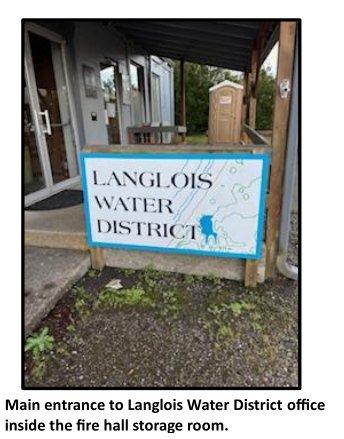
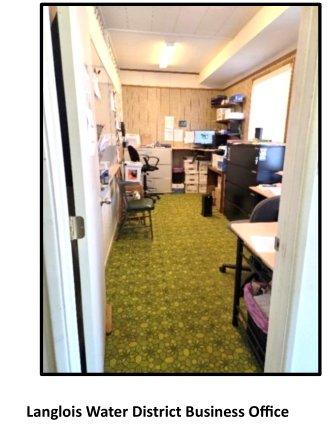
The business office for the Langlois Water District is located in the fire hall at 94322 First Street. The constricted office is in a corner of the hall’s storage room and was appropriated by LWD in 1971.
The space measures 8’ x 17’ and is shared by the water district manager and clerk. Presently, (March, 2026) only outdoor toilet facilities are available for workers, clients, and people who have business to conduct with LWD. Office rent paid to the Langlois Fire Department is currently $300.00 per month. Langlois Water District is not in a financial position to pay for office space in a separate building.
Though today’s business office is a modest one, keep in mind that years ago, bill payments were made at various unrelated business places in town. Account records were kept on vertical index cards stored in a long narrow wooden box that passed from one business site to another depending on who was accepting payments and writing receipts. Historically, the box passed from LaRue Henry at Cheever Hardware in the 50’s and 60’s, then to Ethel Boston at Langlois Market in the 60’s, and finally to Georgia Van Wormer in the 1970’s. Georgia and her husband Jack owned and operated the Union Station on the south side of town. Archived records were generally stored in the residential home of a willing LWB member.
LONG-TERM CAPITAL IMPROVEMENT NEEDS:
• From the Dyer Partnership Engineers and Planners, Inc. Water Plant and Water Tank Feasibility Study of 2020:
Needs include a new raw water intake/pump station; raw water storage tank; filtration unit for the water plant; and a treated water storage tank of 125,000-gallon capacity. Also mentioned in the report is the need for extended lab and storage space, and indoor toilet facilities. The total estimated cost for installation and construction of these improvements is $3,079,810 based on 2020 figures.
• Jesse Crim, acting Langlois Water District Manager: At the top of Crim’s list is the need for a filter system and 50,000 gal. raw water reservoir to replace the current 10,000 gal. capacity tank.
• Langlois Water Board: Board Chair, John Waller, responded: “Currently we are following the Dyer Partnership report in assessing the needs for our water plant. The report outlined the phases needed to make major upgrades without total disruption of providing water to our community which is our primary responsibility. We as a board have held open in-person meetings, one at the Langlois Public Library for a planning session to discuss this issue and, an additional in-person open public meeting at the Langlois Fire Hall to discuss the budget. At both meetings we had a small public input mostly from volunteers familiar with the Langlois Water District. Because we are working on a shoestring budget, the monies needed for major upgrades is a big challenge.
“We need to upgrade our water intake and associated storage first. This will allow us to have more water on hand to treat and put into storage. Almost all parts of the water system are past their expected life span with the exception of recent upgrades in the water treatment process to keep up with the required quality of water for our customers and to help our employees in the process of producing that water. We as a board are looking into grant opportunities wherever they may be available”
FINDING FUNDS:
Systems that run 24 hours a day, 7 days a week every week of the year can be expected to show deterioration of major parts periodically. Knowing that, Hal Fitzgerald, who joined the LWB in 2017, secured a Community Development Block Grant (CDBG) in the amount of $10,000.00 to finance a feasibility study by Dyer Partnership Engineers & Planners, Inc. of Coos Bay. The projected long-term needs outlined in that study would be used to complete an application for a Community Development Block Grant (CDBG) of 2.5 million dollars offered by Business Oregon, an economic growth agency. If LWD were to be favored with such a grant, it would go a long way in covering the projected $3,079.810. price tag quoted in the feasibility study. Because Langlois is not an incorporated city, the application required the input and stewardship of the Curry County Board of Commissioners. Hal Fitzgerald decided to pursue it and related his experience following the successful completion of the feasibility study:
“...The next challenge was to receive funds and get contracting done as per our Dyer engineering report and survey. Upon working towards the next phase, we were informed through Business Oregon (I believe) that those funds could not be under the direct management of Langlois Water District because we were not a certified town or municipality and we would have to go through Curry County who would be our higher. I notified Curry County.” ---Hal Fitzgerald, Former LWD Board Chair
The minutes from the Curry County Commissioners’ meeting of June 5, 2024 verify that they were working with Langlois Water Board on a grant, and indeed, the commissioners prepared an Intergovernmental Agreement (IGA) to be signed by Hal Fitzgerald on behalf of the LWD Board. Discussions and a Zoom meeting ensued between the Curry County Attorney, Ted Fitzgerald; a representative from the Curry County Planning Commission; and Hal Fitzgerald, LWB chair. Hal Fitzgerald questioned some of the conditions Curry County had set forth in the IGA. Reportedly, Curry County wanted the Langlois Water District to do what he (Hal Fitzgerald) felt they had “no authority for the County or expertise in handling,” and, among other issues, he questioned the 20-30% fee the County wanted for their role in management and overseeing of funds. Additionally, he was concerned about the minimal direct support offered in preparing the IGA that had to be filed with the Business Oregon grant application. He was told by a representative speaking on behalf of the Curry County Commissioners that they (Curry County) would rewrite the IGA and resubmit it to Hal Fitzgerald for his signature. According to Hal Fitzgerald, that did not happen despite free help and direct communication offered by the Community of Economic Development Directors Office in Salem, OR which was willing to work with Curry County on development of a functional IGA that would delegate responsibilities to the correct organizations (including Business Oregon).
Without the rewritten IGA from Curry County, the Langlois Water District grant application could not be submitted, resulting in the loss of a 2.5-million-dollar grant opportunity for LWD. Discouraged after so many seemingly wasted hours of work and frustration over a three-year period, Hal Fitzgerald did not seek election for a third term to the Langlois Water Board.
The importance of grant allocations to Langlois Water District cannot be overstated. Depending on the data collected and the boundary chosen, Langlois has a population between 189 to an unfathomable 500, both figures from 2026. Because it is unincorporated, there is not an official boundary for census purposes. The most likely population figure is around 200, most of that number being senior citizens with modest incomes. Even with taxing authority, it is difficult to accumulate funds to maintain an adequate, reliable, and safe water system, and it is reasonable to conclude that LWD will always need grant and loan money to survive. Since 1956, every major improvement has required a loan or a grant. Some examples include: The HUD grant of 1981 in the amount of $135,000; the Curry County loan of 1976 for $175,000; the Oregon Community Development block grant of 1986 for $2,000; the 1987 Oregon Community Development program; the 2007 USDA Rural Development grant for $500,000; and the Community Development block grant of 2019 for $10,000. Grants are generally written by volunteers who may or may not be LWD members or even local citizens. The imminent needs enumerated in the Dyer report are even more pressing today than they were when the report was written more than five years ago. Yet, there are no grant applications for LWD in the works today.
SUMMARY:
From the Dyer Report of 2020: “In Curry County, the water departments in Harbor, Brookings, Gold Beach, Nesika Beach, Port Orford, and Langlois all need system improvements, a common predicament throughout the state.” ..... “The Oregon Dept. of Agriculture, Oregon Dept. of Fish & Wildlife, Oregon Water Resources Dept., Tribes, Water Watch and local governments all have a say and must form alliances to begin the process.” (
See Note20) Is it possible that solutions can be found through the consolidation and/or cooperation of the various governing bodies?
Langlois H2O. What will its legacy be? Hopefully, and in due course, knowing its history will inspire the collective unity and energy needed to assure its future.
Read more about Langlois H2O History of Langlois Public Water by Bonnie Jensen Cox, April, 2026