
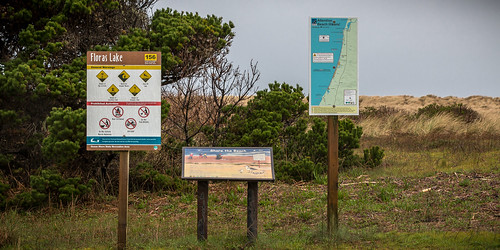
Floras Lake






An Oregon ranch is challenging federal management plans for a 63.5-mile stretch of the Rogue river, arguing they’ll impede stabilization of the volatile river channel.
The Double R Ranch of Eagle Point, Ore., filed a lawsuit against the U.S. Bureau of Land Management for adopting plans to protectively manage the segment, which is eligible for designation as a “Wild and Scenic River.”
Aside from hindering permits needed to fortify the river, BLM’s decision will complicate changes to irrigation diversions and the development of water rights, the complaint said.
The lawsuit is joined by the Oregon Cattlemen’s Association, which worries other ranchers will encounter such problems, as well as the Oregon Concrete and Aggregate Producers Association, which fears barriers to erosion control efforts.
Capital Press was unable to reach a representative of BLM as of press time.
In 2016, BLM determined the 63.5-mile segment is “suitable” for protection as a Wild and Scenic River, which is the final administrative step before Congress can make that designation.
However, this particular stretch has a long history of human manipulation, disqualifying it from designation because it’s not “free-flowing” as required by federal law, the complaint said.
“Throughout the proposed segment, streambanks have been extensively modified, armored, and engineered to stabilize the river channel,” the complaint said.
This segment of the Rogue river is prone to “extreme flood events” and channel migration, so further work will be needed to reinforce its streambanks with rip-rap rock and otherwise avoid undesirable upland impacts, the complaint said.
Gravel pits near the channel are susceptible to being inundated or “captured” by the river, which has occurred in the past, polluting the water with massive amounts of sediment, according to plaintiffs.
A coalition of landowners, government agencies and conservationists has rectified past problems, but the U.S. Army Corps of Engineers would “almost certainly deny” future permits for such projects due to restrictions associated with the Wild and Scenic Rivers Act, the complaint said.
“Thus designation of the proposed segment would effectively halt future bank and channel protection activities,” the lawsuit said. “That could result in further pit captures, severely degrading downstream fish habitat and frustrating the very purposes and policies the WSR Act was created to protect.”
The plaintiffs claim BLM’s own analysis found that state and county governments are already protecting the river, so leaving the segment undesignated wouldn’t threaten its wild and scenic values.
“Designation would duplicate local management and could easily undermine it,” the complaint said.
Upper and lower reaches of the Rogue river are already designated under the Wild and Scenic Rivers Act, but those sections flow mostly through public land, according to the plaintiffs.
“In contrast, the proposed segment comprises almost entirely private property, with insignificant land ownership by federal agencies,” the complaint said.
NYSSA, Ore. — The onion growing industry in Eastern Oregon and southwestern Idaho has revamped how it promotes the 1.5 billion pounds of Spanish big bulb onions grown here each year.
Promotion and marketing of those onions has traditionally fallen mostly to the Idaho-Eastern Oregon Onion Committee, which administers the federal marketing order that covers this region.
But the committee in 2015 opted to cut the region’s onion assessment in half, sharply reduce its promotions budget and let onion shippers use the resulting savings, if they chose, to do more of their own direct promotions and marketing.
The assessment was trimmed from 10 cents for each 100 pounds of onions produced to 5 cents. Growers pay 60 percent of that assessment and handlers the rest.
The assessment fee cut did not impact the committee’s research and export budgets.
But the IEOOC slashed the budget for its promotion committee from $635,000 to $250,000.
The 300 growers and 30 onion shippers in the region were left with the option of using the savings realized from the assessment reduction to do their own marketing.
The industry’s customer base has consolidated heavily over the years and because customer lists are much shorter now, it makes sense for individual shippers to more aggressively go after customers themselves, said promotions committee board member Grant Kitamura.
“This gives people more money to promote their own business,” said Kitamura, general manager of Murakami Produce in Ontario, Ore.
At the same time, the IEOCC still maintains a strong industry presence, including at trade shows and industry events, and continues to promote the famous Spanish bulb onions grown here as a regional brand.
The committee spent $61,000 on advertising last year, as well as $7,000 to print 1,000 glossy shippers directories.
“We think we’ve been successful in maintaining our visibility in the industry (even) with the reduced budget,” Kitamura said.
The promotions committee has also turned to the internet and social media more, a tactic designed to reach millennials.
“We are trying to reach out to the next generation of consumers and customers,” Kitamura said.
Malheur County farmer Paul Skeen, a member of the promotions committee board, believes reducing the committee’s budget and allowing shippers and growers to use the savings to do more of their own marketing was a wise move.
“I think we’re still getting the bang for our buck,” he said of the committee’s reduced budget. “We just cut the frills out and went with what’s working.”
Other industry members contacted by Capital Press agreed.
“We’re in favor of that decision and feel it’s working well for our company and our growers,” said John Wong, president of Champion Produce in Parma, Idaho.
Shay Myers, general manager of Owyhee Produce in Nyssa, Ore., was skeptical of the move at first because he worried having shippers do their own promotions and marketing could fragment the industry.
But he has since changed his mind and now believes the new direction is working well.
The Oregon Liquor Control Commission issued its first recall of recreational marijuana after testing of a brand sold at a Mapleton, Ore., store showed it contained a level of pesticide residue that exceeds the state limit.
The OLCC , which oversees retail sales of recreational cannabis, said samples of Blue Magoo marijuana failed a test for pyrethin levels. Pyrethins are a mixture of six chemicals that are toxic to insects, according to the National Pesticide Information Center based at Oregon State University. Pyrethins are found in some chrysanthemum flowers, and in some cases can be used on organic products.
The recall points out some of the complications that accompany the legalization of recreational cannabis. Growers, like all other agricultural producers, now face a regulatory structure they may not have dealt with before.
Pesticide use has been particularly thorny, because the federal government still considers cannabis illegal and has not established allowable tolerances of pesticides in pot. As a result, states that have legalized cannabis are figuring it out themselves. Oregon tests cannabis for 59 active ingredients.
“It’s a big struggle, for sure,” said Sunny Jones, cannabis policy coordinator for the Oregon Department of Agriculture.
The Oregon Health Authority oversees medical marijuana, OLCC oversees recreational marijuana, and ODA regulates aspects that range from food safety regarding cannabis edibles to pesticides, water quality issues and commercial scales used to weigh the product. The recalled pot was grown by Emerald Wave Estate, based in Creswell, Ore., and sold at Buds 4 U in Mapleton, a small town west of Eugene. The OLCC said people who bought the pot should dispose of it or return it to the retailer.
Mark Pettinger, spokesman for OLCC, said the retailer has fully cooperated in the recall. It sold 82.5 grams of Blue Magoo to 31 customers from March 8 through March 10. The store noticed the failed pesticide reading in the state’s Cannabis Tracking System on March 10 and immediately notified OLCC, Pettinger said.
“The retailer was great,” he said. “They get the gold star.”
Pesticide application would have been done at the grower level, which is the province of ODA. Pettinger said the distribution system breakdown occurred when a wholesaler, Cascade Cannabis Distributing, of Eugene, shipped the pot to the Mapleton store before pesticide test results were entered in the state’s tracking system. The testing was done by GreenHaus Analytical Labs, of Portland, which is certified by the state to test cannabis for potency, water content and pesticide residue.
The mistake might qualify as a violation under Oregon administrative rules, Pettinger said. Failure to keep proper records is a Class III violation; the first offense is punishable by up to 10 days of business closure and a $1,650 fine. Four violations within a two-year period can lead to license revocation.
The rest of the grower’s nine-pound batch of Blue Magoo marijuana flower has been placed on administrative hold, meaning it cannot be lawfully sold pending the outcome of additional pesticide testing. Pettinger said the pot is in the grower’s possession.
